How We Homeschool a Large Family with Charlotte Mason | Daily Schedule
This post may contain affiliate links. Please see my disclosure and privacy policy for more information. As an Amazon associate I earn from qualifying purchases.
Homeschooling a large family means finding a balance between structure and flexibility. When you add the Charlotte Mason method with its emphasis on living books, short lessons, and a wide feast of ideas, it can feel like a big task to fit everything in.
In this post, I’m sharing our Charlotte Mason homeschool schedule for our large family. It’s not perfect, but it works for us! With children ranging from preschool through high school, our days have to run smoothly while still leaving room for beauty and peace.
Morning Time: Starting Together
We begin every day gathered at the table for Morning Time. This is our anchor point before everyone scatters into their own lessons. During Morning Time we enjoy:
- Bible or poetry reading
- Hymns or folksongs
- Memory work
- A read-aloud
- Artist or composer study
This shared learning time sets the tone for the day and ensures that, no matter what, we’ve connected over truth, beauty, and goodness.
Independent Work for My Older Kids
After Morning Time, my older children (7th, 9th, and 11th grade) move into independent lessons. They are mostly self-directed at this stage, but I have a daily check-in scheduled with each of them. During this time, I look over their work, answer questions, and help them stay on track.
Some of their independent work includes:
- Math
- History readings
- Science
- Written narrations
- Language arts assignments
- Online classes
This independence frees me up to focus on my younger crew while still keeping a pulse on their progress.
Working with the Younger Kids
For my three younger students, I rotate one-on-one lesson time with each child. While I’m working closely with one, the others stay busy with things they can do on their own, such as:
- Reading Eggs
- Handwriting practice
- Language arts assignment including handwriting and copywork
- Independent reading
This rhythm keeps everyone engaged without too much waiting around. My preschooler bounces between playing with a sibling, listening in, or entertaining herself with toys.
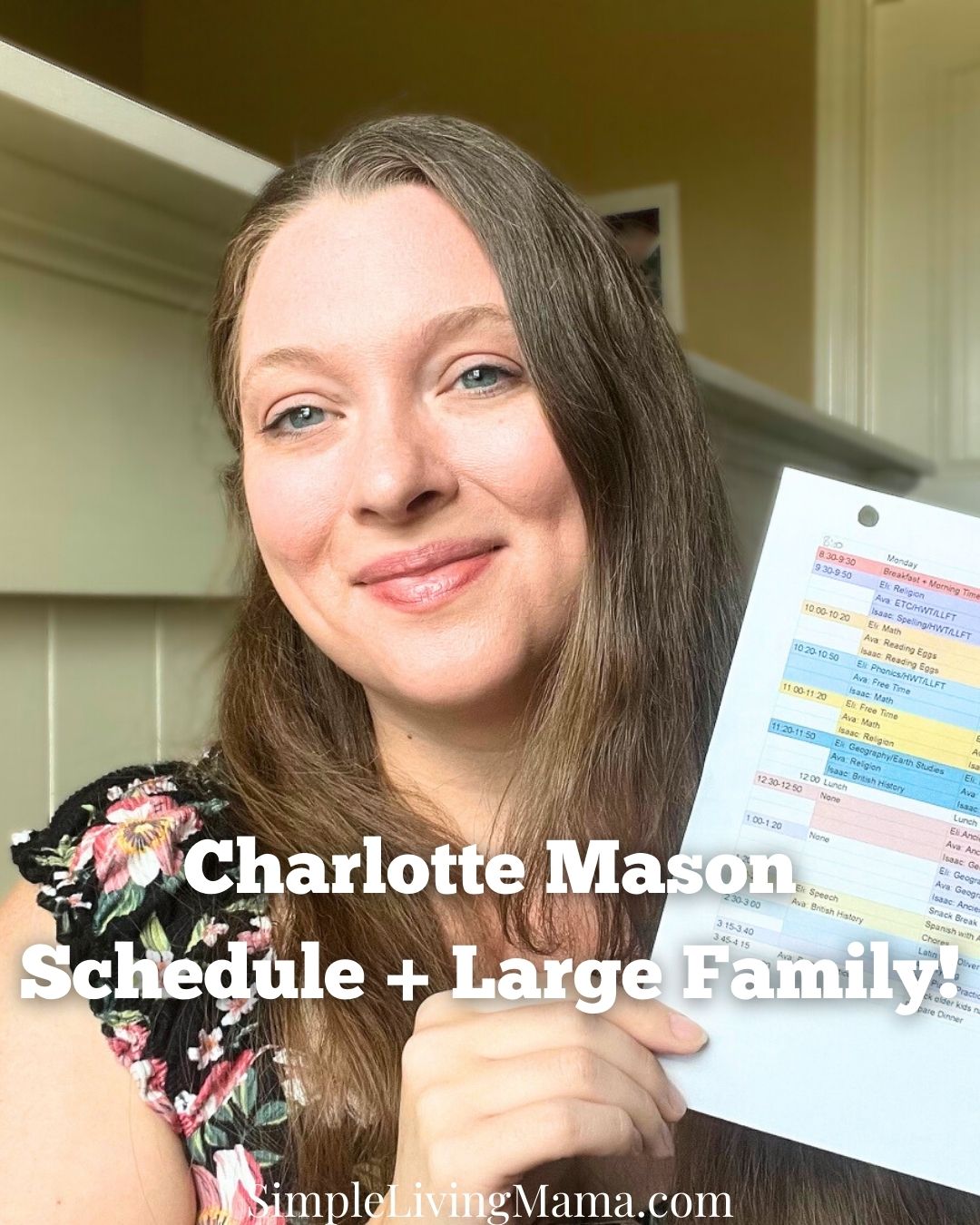
Looking at the schedule below, I know that it is likely to change. For example, when I made this schedule I didn’t realize we needed to do Latin and Spanish daily, so I’m going to try to adjust our Morning Time to allow Latin in the mornings, and then I’m going to find a spot for Spanish later in the day.
I also want some one on one time with my preschooler. I’m planning to see how our days go before deciding where I want to add that time. This schedule is just my tentative idea, and it will change!
Another advantage of the Charlotte Mason method especially with younger children is short lessons. Several of these subjects will not take as long as I have allotted on the schedule.

A Loosely Timed Schedule
While I prefer to keep a gentle rhythm rather than a rigid clock-based schedule, we do have to keep an eye on the time because we leave for speech therapy twice a week. On those days, I keep the mornings focused so we can transition smoothly out the door.
Afternoons: Occupations + Enrichment
On the days we’re home, afternoons are reserved for enrichment and practical skills — things Charlotte Mason often called “afternoon occupations.” Some of these include:
- Art lessons
- Music study or practice
- Typing
- Handicrafts
- Free play outdoors
These slower-paced afternoons balance out the more focused mornings and give everyone space to enjoy learning in a relaxed way.
Weekly Schedules for Each Student
I found these lovely templates you see below on the Ambleside Online Facebook group. I modified them for our Mater Amabilis curriculum and will place them on clipboards for all of my children in 2nd-7th grade. This allows them to see what they are doing throughout the week.

I also think it will help them foster some independence in their learning, and it will also serve as a way for me to keep records of what they accomplish each week.

Homeschooling a large family with Charlotte Mason isn’t about checking every box or having a perfectly timed schedule. It’s about creating a rhythm that works for your family, while keeping the heart of Charlotte Mason’s philosophy alive — short lessons, living ideas, and plenty of time for beauty, nature, and creativity.
If you’re homeschooling with multiple ages, I hope this peek into our daily schedule encourages you. Your homeschool won’t look exactly like ours, but with a little planning and flexibility, you can find a routine that fits your family too.